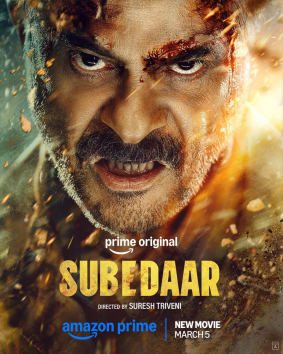
Full disclosure: I’ve just made a Netflix show with Anil Kapoor. Aditya Rawal plays Nibras in my film Faraaz and has an integral role in Gandhi. Neither fact disqualifies what follows. Both are forces of nature — and that is where any fair-minded review of Subedaar must begin.
There is a phrase that keeps returning to me after watching this film: newness in familiarity. A newness in craft, a familiarity in theme. A newness, most of all, in the fact that films like this simply aren’t made anymore — and after the 1980s, most of us assumed that was probably for the better.
Subedaar made me reconsider that assumption.
What Suresh Triveni has done here is reach back into the cinema of that era — the seething rage of the angry young man in Zanjeer, the traumatised interiority of Deewar, the rawness of N Chandra films, the villain without a shade of grey, a hat tip to the films of K Raghavendra Rao— and found something genuinely alive in it. Not nostalgia for its own sake, but an honest reckoning with why that cinema worked. The gradual release of unfiltered rage. The Syd Fieldian penultimate act. The climax designed, unapologetically, to satisfy. Set piece after set piece, each crafted with the finesse of say a Mukul Anand — from a director who has already given us gems as tonally distinct as Tumhari Sulu and Jalsa. This is an unlikely film from that man. In a good way.
There is no greater pleasure for me, as a filmmaker, than watching another filmmaker abandon their comfort zone. Triveni pays tribute to the unapologetic 80s in his own inimitable style — smartly written, deftly acted. Does Subedaar have uneven edges? Yes. But even those feel like part of his overall scheme — deliberate roughness in service of something larger.
And this one, set in the heartland, is no Gangs of Wasseypur — thankfully. The clones and the hat tips to that film have become tiring and increasingly unwatchable. This goes its own way.
Now, Anil Kapoor.
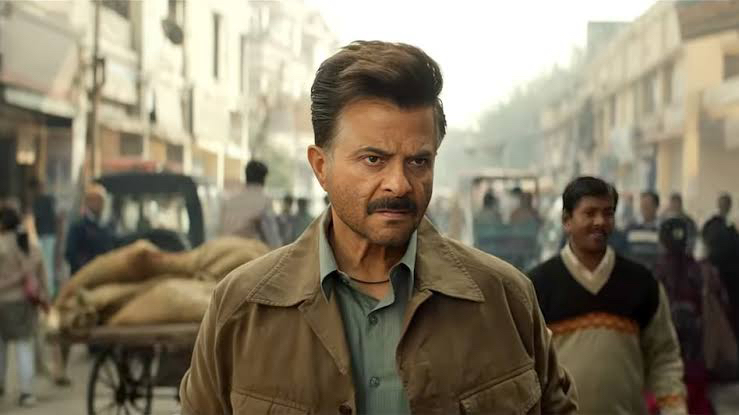
I will say it again and again: he is a force of nature. And that designation has nothing to do with his now-legendary refusal to age. It has everything to do with his complete surrender to a film, his commitment to a director’s vision, his total immersion in performance. He commands the screen not because he demands it, but because the screen deserves him. And so does the cinema hall.
Aditya Rawal digs into evil with glee and with zero pretence. His Prince is a hat tip to the villains of the past — men who are, unfortunately, a very present reality. To watch Prince fight a losing battle against his chacha, and to see him allow the character to rise above his own ego, is to witness the work of an actor whose time in the sun is not distant — it is imminent. To play a part like this without vanity is a rare and unmistakable sign. Actor, screenwriter, playwright, producer, footballer: this multi-hyphenate is here to stay. Watch out for him.
Radhika Madan deserves better than what our cinema has given her so far — better parts, better films, more opportunities. As the feisty but internally wounded daughter, she does not shy away from ugliness in service of her character. That is courage. That is craft.
Mona Singh — what a year she is having. And deservedly so. Her role here may have lesser dimension than Kohraa 2, but she does enough with it to reaffirm what is becoming increasingly undeniable: she is an actor of exceptional calibre.
And Saurabh Shukla just keeps doing it again and again — putting conviction and life into characters that are underwritten and under-serviced by an already densely plotted, sometimes clumsily executed screenplay. There is a quiet mastery in that. The ability to make a screenplay’s gaps invisible is a gift very few actors possess.
Last, but never the least — what a beast. Faisal Malik. In another industry, a certain Vijay Sethupathi has entire films written around him — and the comparison is not merely physical. Faisal Malik deserves the same, and more, in Hindi cinema.
One question the film raised for me: would this have worked on a cinema screen? The cinematography, sound, action and overall ambition of the film all strive to be as cinematic as possible. The smaller screen looks like a strategic precaution in an uncertain theatrical environment.
There is no way to know now. But the question lingers.
As I said at the outset — there is a bias in my view. I have tried my best to be truthful to my experience. And to my bias.
 Hansal Mehta – Filmmaker | Director | Writer | Official Website
Leave a comment