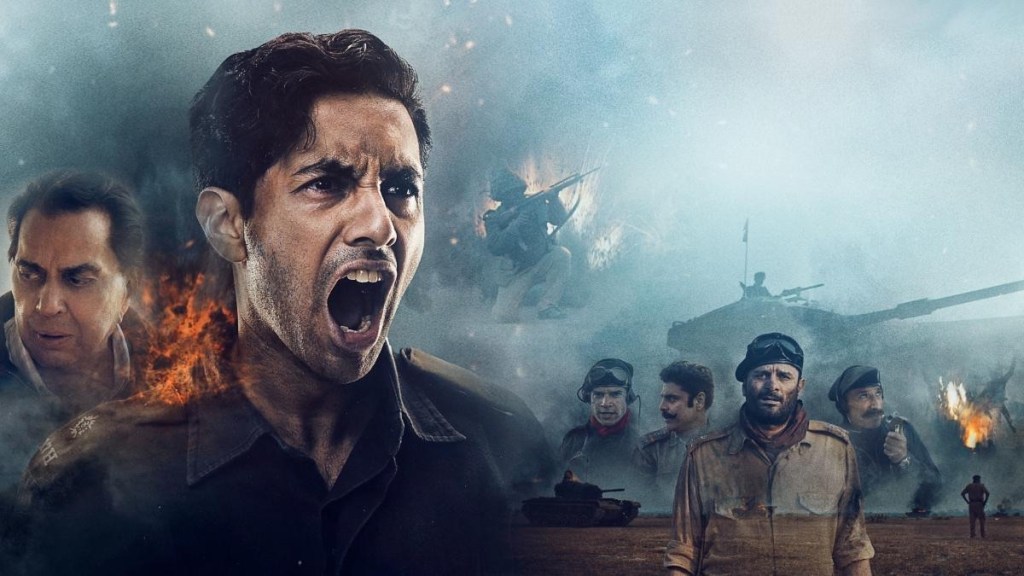
I watched Ikkis. Somehow the promos never pulled me to the cinemas. Bas naam hi kaafi hona chahiye tha — Sriram Raghavan. A war film from Raghavan seemed like either something he was forced to do, or something he wanted to but it wasn’t what he intended it to be.
Happy to report from Prime Video, where it is streaming — it’s none of the above. Not experiencing it at the cinemas is entirely my loss.
In the times of hypermasculinity, rabble-rousing and loud jingoism comes a war film that is not about war but about its sheer futility. A film that makes your heart bleed for all — including those that have been ordained your enemies by people who live safely in their power chambers. This is rare, even radical — a mainstream Indian war film that doesn’t ask you to pick sides but instead asks you to grieve for everyone.
It is a most gentle, soft and romantic film about war. A film that flows like a tale you never want to end, with characters you always want to love. This one’s an ode to cinema, brotherhood and cinephilia in the true Raghavan mould. You can sense his deep love for the medium in every frame — in the way he lingers on faces, in the way silence is allowed to do the heavy lifting, in the way the story trusts you to feel rather than telling you what to feel.
The scenes are mature in their treatment, the world feels fresh, the young ones feel refreshingly young — from an era where being young meant being shy and not toxic. Where men could be soft and their bodies need not have cuts and muscles to have soul. There is something deeply moving about a film set during war that celebrates tenderness. It is a quiet act of defiance — against the chest-thumping, against the noise, against the idea that love and valour cannot coexist.
The cinematography by India’s Deakins — Anil Mehta — is remarkably restrained and yet always cinematic. There is a quality of light in this film that feels like memory itself — warm, golden, slightly fading at the edges. The war sequences, particularly the day-for-night and night sequences, are quite stunning without being showy or loud. The use of flashbacks and the non-linear screenplay work so seamlessly — as gently edited as it is shot. The sound design is great, creating an immersive landscape that pulls you into both the tenderness of peacetime and the terror of the battlefield. The music works beautifully as background score, but the songs jar in their extreme Saiyaarisation. Whose choice were they anyway? In a film this delicately calibrated, they feel like interruptions from a different movie.
Agastya Nanda is charming and so, so earnest — here’s an actor who got a befitting debut in this film. A film he deserves. I’m really interested in what he does in the next few years. There is no performance here — there is being. He inhabits the role with a naturalness that is rare for any actor, let alone a newcomer. Very few gentlemen left in this business — this kid’s one of them, on and off the screen. Simar Bhatia, playing his love interest Kiran, is also refreshingly normal and a wonderful addition to a new generation of talent. In her limited screen time she brings a warmth and groundedness that makes you wish the film had more of her — a debut that quietly announces real potential.
The ensemble in most part is all very efficient and quite excellent — Rahul Dev, Sikander Kher, Vivaan Shah never miss a beat and lend the film solidity. Even Deepak Dobriyal and Asrani are lovely in their limited parts. Every character, no matter how brief their appearance, feels lived-in and real — a testament to Raghavan’s gift for casting and his respect for every corner of his ensemble.
Last words for two men — Jaideep Ahlawat and Dharamji.
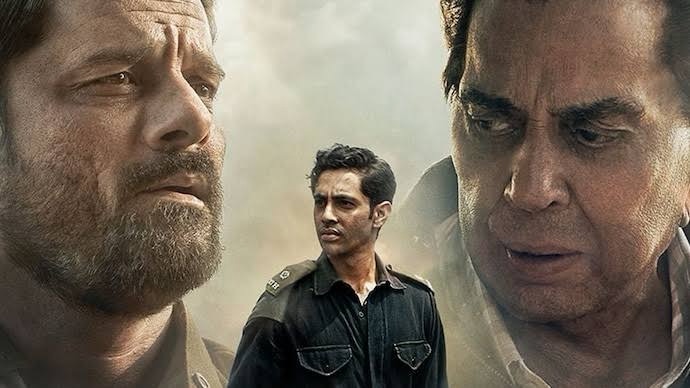
Jaideep is a genius. True genius. Regret, empathy and the heart of a soldier are writ large in this remarkable actor’s remarkable performance. His eyes, his body language — impeccable. There is a scene where he simply looks at Dharmendra and you can feel the weight of decades, of guilt, of a war that never really ended for either of them. Jaideep is a true thespian. One of the finest we have. A man who makes every film he’s in better simply by being present.
Dharamji — with those misty eyes, the far-away look and the beautiful warmth — leaves behind a tale and performance full of humanity and love. A reminder that men were once soft, and in their softness there was virtue. There is a grace in his presence here — an old soldier, an old father, carrying a lifetime of loss with quiet dignity. It is impossible to watch this performance and not think of all the fathers who never got to see their sons grow old.
Farewell, Dharamji. You left well. With a cinematic gift.
Thank you, Sriram Raghavan, for the movies. For refusing the easy path. For making a war film that is really about peace. For reminding us that the best cinema doesn’t raise your pulse — it breaks your heart.
Truly a modern master.


 Hansal Mehta – Filmmaker | Director | Writer | Official Website
Leave a comment