Rivals – Art as Guilty Pleasure, or Vice Versa

I first heard about Rivals when the International Emmys were announced a few weeks ago. A Disney/Hulu show, apparently. What surprised me more was that it had been available all this while on our very own JioHotstar. Quietly sitting there, unannounced, un-hyped, waiting to be discovered.

So I watched.

Then I read up a little.

The series is based on Jilly Cooper’s novel of the same name. I haven’t read the book so I’ll restrict myself to the show and perhaps that’s the best way to encounter Rivals anyway. Unburdened by fidelity tests, nostalgia or the anxiety of comparison.

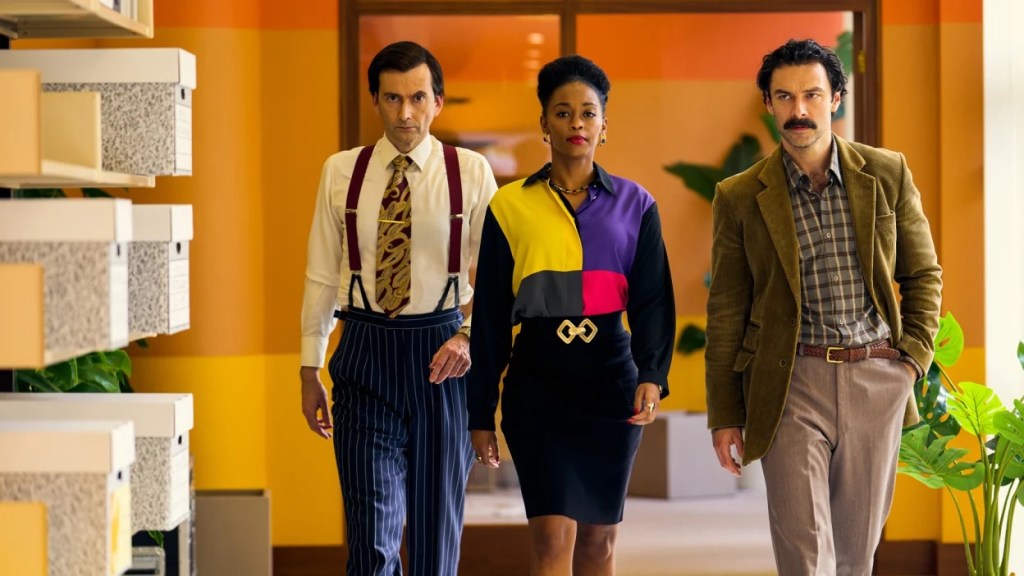
What struck me almost immediately was how confidently Rivals announces itself. This is a show that knows exactly what it is and is completely at ease with that knowledge. It doesn’t hedge, apologise or posture. It is glossy, decadent, unapologetically sexy, soaked in the excesses of the 1980s and yet beneath the silk shirts, shoulder pads, and sharp suits it is unmistakably intelligent television.

A stellar cast helps. Tremendous actors, all of them. Performances that feel lived-in rather than performed. Dialogue that snaps and crackles with wit. Satire that doesn’t scream for attention but lands its punches with elegance. Social critique that is embedded in character rather than delivered as sermon. And character arcs that actually arc – messy, contradictory, flawed, and recognisably human.

Yes, there is a lot of sex. And thank god for that.

What’s refreshing is not merely the presence of desire, but the absence of shame around it. Rivals treats sexuality as a fact of life : a driving force, sometimes ridiculous, sometimes destructive, often tender but never something that needs to be apologised for, sanitised or dressed up as empowerment rhetoric. As one of the many stellar lines in the show so aptly suggests, morality is often just a convenient costume we wear over our appetites.

That to me is one of the show’s quiet provocations.

Does it falter? Of course. Somewhere in the middle episodes the storytelling leans into familiar tropes. The rhythms become predictable. The indulgence occasionally tips over into excess. But even then it never collapses into mediocrity. It remains assured, entertaining and watchable. And when it regains its footing it rewards the viewer with something increasingly rare – television that understands payoff.

By the time it ends you realise you’ve been in the hands of storytellers who respect both their audience and their craft.

And that brings me to the larger point.

Watching Rivals reminded me once again of why the British are bloody good at telling stories. There’s a confidence there. A refusal to be embarrassed by intelligence or pleasure. A comfort with contradiction. A belief that popular entertainment does not have to be stupid to be successful nor austere to be artistic.

Around the same time I watched an American show that desperately wanted to feel British – mannered, edgy, “classy” but ended up feeling forced, underwhelming and hollow. It was all surface and no spine. An imitation of tone without an understanding of why that tone works. More on that some other time.

What I hope streaming executives – especially closer home take away from Rivals is this: television can be sexy, silly and smart at the same time. These qualities are not mutually exclusive. Popularity does not demand creative compromise. Audiences are far more perceptive, far more adventurous and far less prudish than we give them credit for.

There is so much to learn here – from the writing, the performances, the tonal confidence, the refusal to condescend. From the courage to let characters be flawed, selfish, libidinous and contradictory without immediately punishing them for it. From the understanding that entertainment and art are not enemies – they are collaborators.

This is the kind of show that reminds you why you fell in love with television in the first place. Why the medium matters. Why it can be both a guilty pleasure and a serious artistic pursuit.

It’s a lesson I’d like to keep learning myself.

And one I hope my colleagues on the other side of the table learn too.

Together, we really can make great stuff.

Rivals, it is. Perhaps the best fun I’ve had watching TV in a long time!

Train Dreams – An Essay

Some films arrive like a whisper. You don’t notice them at first. Then they settle inside you and refuse to move. Train Dreams is one of those films. Clint Bentley and Greg Kwedar’s adaptation of Denis Johnson’s novella is quiet and unhurried, almost deceptively simple, but somewhere along the way it opened a small window inside me. It reminded me of why I fell in love with cinema in the first place.

Watching it took me back to 1994 when I first saw Kieslowski’s Bleu. I remember leaving the theatre with something rearranged within me. I felt that again here. A gentle shift. A soft turning of some inner wheel.

The film drifts through nearly eighty years of Robert Granier’s life. A man who seems to live inside himself even when he is with the people he loves or the men he works alongside. His solitude is not dramatic. It is simply who he is. A condition of being. The film treats it with a kind of respect. A patience. It allows him the quiet he needs.

What struck me most was the use of voice-over. In so many films it feels like a crutch, like a shortcut for narrative bankruptcy. Here it becomes part of the breath of the film. You don’t hear it as narration. You hear it the way you hear your own thoughts when you are walking alone. Soft, unforced, present but never demanding attention. It blends with the landscape, with the forests and rivers and the changing seasons. The film lets nature speak. And it listens.

Everything that matters : love and grief, cruelty and tenderness, life and its inevitable vanishing – appears visually. The film trusts the viewer to see, to feel, to understand without being told. It is visual poetry held together by the prose of human experience. A balance that is rare.

As a filmmaker, I felt grateful watching it. There is a kind of democracy in its creation. A belief that cinema belongs to those who are willing to imagine and to wait. Those who allow the story to breathe. Those who listen more than they assert. Films like this make the medium feel wide and generous again.

After Adolescence, Netflix has surprised me once more by bringing a film like Train Dreams into our reach. Even if they were not involved creatively, simply making space for a work like this is contribution enough. Sometimes all a platform has to do is open the door.

Train Dreams left me with a lingering stillness. A sense of something quiet but important passing through. I think that is the best a film can do.

Rohith’s Last Words

The death of a 26 year old PhD scholar at the Hyderabad University on 17th January 2016 disturbed me. Rohit Vemula’s death continues to disturb me very deeply. That someone so young should even contemplate suicide is disturbing enough. That he did commit suicide gives me sleepless nights even now. Was it cowardice? Was it despair? Was it discrimination? Poverty? Caste? Loss? Pain? Protest?

I do not endorse suicide. The act is neither symbolic nor worthy of my sympathy. However, in Rohith Vemula’s letter I found expression to my own despair at the way our constitutional freedoms are systematically being snatched away by an apathetic establishment. His last letter is a reflection of how our polarised social order has made it impossible for the ‘other’ to even aspire for equal opportunity. His last letter made me realise that sometimes what we deem as suicide is actually an act of collective murder by a stifling society and a dictatorial establishment.

Here is my tribute to Rohith. Here is the last letter of a sensitive young man who should not have died. Here is Rohith Vemula’s last letter.

Narrated by Mohammed Zeeshan Ayyub
Translated by Swanand Kirkire


with thanks to :
Arnab Gayan, Apurva Asrani, Harshit Sharma, Alok Tripathi, Vipul Arora


Twenty Years On The Fringe – Incoherent Ramblings

Image

In 2014 I completed roughly 20 years in the industry – of course encompassing my work as a TV producer/director, editor and filmmaker (and atrocious makeshift actor at times). I call these 20 years my life. The remaining years were another life, led by another person, lived by another soul. In 1994 I was a directionless 25 year old bored of computer software, a failed entrepreneur, a young father and basically a young man without a vision for life. 20 years later not much has changed. Except the fact that I have survived. I have survived these 20 years like many other nameless, faceless individuals do in this industry – on the fringes.

Being on the fringes of this industry means that –

  1. You rarely get invited to parties or premiers or previews.
  2. You don’t get written about often. Your personal life is very personal and is of no interest to anybody.
  3. You are rarely / never perceived as a threat to established insider stereotypes.
  4. You don’t expect or win awards.
  5. You make less money.

Essentially, this oblivion means that you can focus on work, lead a simple life and most importantly it means that you do not have to be politically correct all the time. Being on the fringe also means that your mediocrity is often looked down upon as mediocre and you have to ensure that your most mediocre work is less mediocre than the insider’s least mediocre work. You can also be irreverent, impolite, even honest and fearless as an outsider – your survival after all does not depend on your conformism or your sycophancy.

Yes, there are disadvantages, mostly self-inflicted, of being a fringe player. You can get cynical very easily as you see those less talented and more fortunate than you get all that you believe you deserve. You can get very bitter and you can waste immense amounts of time limiting your own creative growth. Nothing will ever seem worthy of your appreciation – not even your own work. Yes, cynicism is the greatest danger posed by oblivion as you will soon be unable to look at yourself in the mirror and you will constantly lower your own standards to belong to a place that you will never belong to.

I write from experience. I was once happy in my oblivion. Then I was dissatisfied. I desperately wanted to belong. I got cynical, frustrated and directionless. I stopped holding a mirror to myself. Fortunately, failure helped me recognize this. I took some time off from myself and my ego. Today, I am comfortable in my own little world. Shahid emerged out of this comfort with my own aspirations and my own inner self. I now inhabit an independent universe that is driven by me, my own benchmarks for growth and my own levels of satisfaction.

I write this because I see many like myself fall prey to the perceived pressure of oblivion and because I see them afflicted by the rampant mediocrity around them. I often see these people fading away and resorting to desperate measures that either undermine their talent or see them fading away beyond the fringes that they belong to. The truth is that being an outsider is far more fulfilling than having to belong to a place that you never belonged to in the first place.

Love Lust etc

Longing is punishment. Yearning is torture. Unleashed by forces. Beyond our control. Motivated by a concept. Called love. Fueled by a nuisance. Called lust. Controlled by a demon. Called passion. I yearn for you. Long to be with you. Dream about us. Remember what was. Imagine what could be. Unable to endure. What is. Without you. I am weak. I am mortal. I am incomplete.