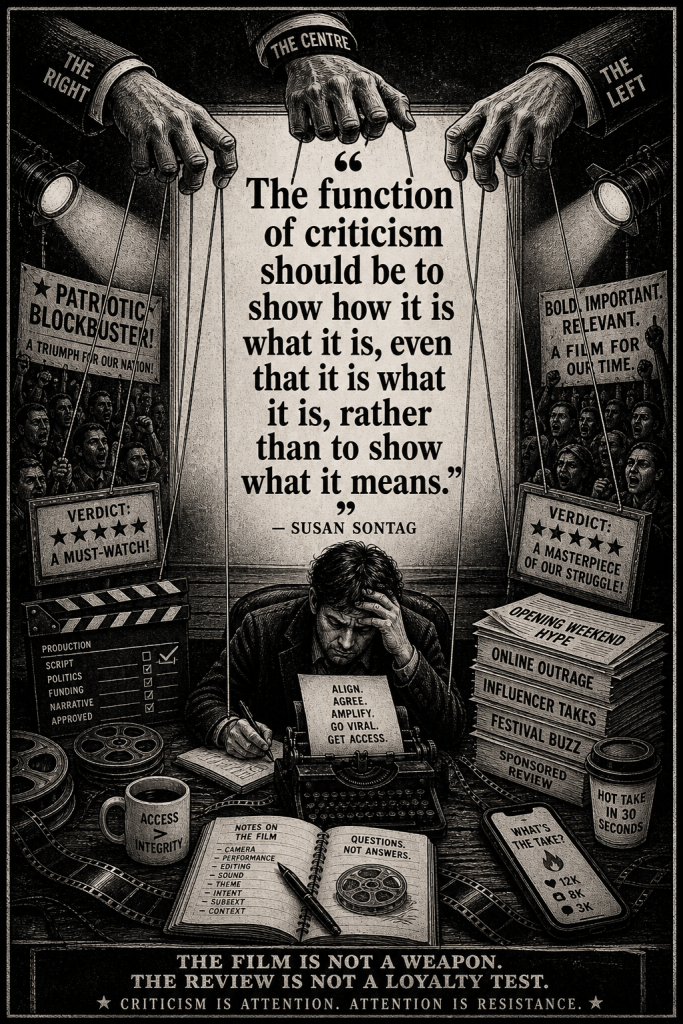
A film opens. The reviews are written before it does. Not by the critics — by the audience the critics now exist to confirm. One side has already decided the film is patriotic; another, that it is propaganda. A third, that it is a serious work of national life; a fourth, that it is a betrayal of the same. By the time the writer has actually watched it, the sentences are waiting for them. The writer’s only remaining choice is which set of sentences to walk into.
This is the condition film criticism now operates in. It is not a complaint about the internet. It is not, in the main, a complaint about the writer, who is mostly the inheritor of an arrangement rather than its author. It is an observation about what popular culture has become, and about what film criticism — the real kind, the kind that was once a form of public thinking — would have to do to be anything other than a service industry to the consensus.
It would have to resist popular culture itself.
I do not mean popular in the sense of widely loved. I mean popular in the sense of pre-agreed. Popular culture, as the term operates in this country in this decade, is no longer the culture of the people. It is the culture of consensus. It is what we are told, before we have watched a single frame, that we are required to feel. It is the film the right has decided is patriotic. It is the film the centre has decided is prestigious. It is the film the left has decided is correct. All three produce films. All three produce verdicts on those films. And all three demand that the writer fall in line, and reward the writer who does.
The honest critic must resist all three.
This is harder than it sounds. Each side offers the critic a costume, a community, and a career. The right wants the cultural defender — write about the film as a flag, and the audience comes pre-built. The centre wants the responsible adult — write about the film as a serious matter of national life, and the masthead stays funded, the access stays warm, the dinners stay on. The left wants the dissenter — write about the film as a gesture of resistance, and the festival circuit returns the call, the panels keep coming, the next list has your name on it. Each sells the writer something that resembles meaning in exchange for the right to be read.
What is sold, in every case, is the film itself.
Because once a film has been assigned a side, the sentences about the film are no longer about the film. They are about which side the writer is on. The film becomes a vehicle for sorting; the review becomes a loyalty test; the reader is no longer being told what is on the screen, only what to feel about the people who put it there. This is true for the propaganda film. It is just as true for its opposite — the film that is loved because it is the right kind of disliked. The mechanism is the same. The film disappears.
It is worth describing what it looks like when the film does not disappear, because that is the work that is going extinct, and it should be named.
A writer sits with a film. They watch it once for the experience and once for the work. They notice what the camera chose, and what it refused. They notice where the cut landed, and where it could have landed and didn’t, and what that decision meant. They notice what the actor did with a line that the line did not give them. They notice what the film means to do and whether the film does it. They notice what the film is hiding — every film is hiding something — and whether the hiding is craft or evasion. They place the film in the company of other films, not to score points, but because no film exists alone and the comparisons are part of seeing it clearly. They build an argument the reader can disagree with. They write the sentence that is true to the film, not to the conversation around the film, and they revise it until it carries the right weight. None of this is glamorous. None of this is paid well. None of this happens at the speed the publishing cycle now demands.
It is, simply, the work. And the work is what is being lost. Not opinions; opinions are everywhere. Attention.
Look at any film opening in this country today and you can map, in advance, the seats around it. Marketing has its position, which is whatever sells the film. The political wing has its position, which is whichever audience the producers have decided is most useful. The festival programmer has a position, often quietly aligned with the funders. The peer group of fellow filmmakers has a position, which is whatever does not embarrass them at the next dinner. The publication has a position, which is whichever access it cannot afford to lose. The platform has a position, which is whichever number does not slip. None of these seats are permitted to be wholly honest. Each pays for its existence in a currency that is not honesty.
What remains? The writer at the desk.
The writer at the desk is also being squeezed — by economics, by access, by the slow tightening of what publications will pay to print. But the writer at the desk is the last seat in the room where honesty about the work itself is still, technically, allowed. That permission is structurally fragile. It is being negotiated away — paragraph by paragraph, byline by byline, year by year. The loss of that permission is not a small professional matter. It is a political event. The writers still using the permission while it lasts are doing something that almost no one else in the cultural sphere is doing.
Two ways the writer is being absorbed are worth naming, because they are often confused for each other and because they come from opposite ends of the same machinery.
The first is the slow conversion of the critic into the publication’s diplomat. The writer who was once paid to look at the film is now paid, in effect, to maintain the relationships the publication can no longer afford to lose. The interview replaces the review. The cover story replaces the argument. The byline becomes a relationship. The teeth are still there. They are simply not allowed to come out. This is not, in most cases, a moral failure. It is a structural one. The publications that once paid for serious criticism are dying. The ones that survive are surviving on access — early screenings, exclusive sit-downs, the embargoed interview, the branded festival coverage. The individual writer, in most cases, did not choose the conversion. They woke up one morning and the job had quietly become a different job. Call this the centre’s trap.
The second is the curated visibility of the safe dissenter. The writer invited to every roundtable, every panel, every list, regardless of what they have most recently written or made — the writer whose dissent is what admits them to the room. The dissent is the disguise; the safety is the position. To write critically about the work of such a writer, or about the films of the filmmakers in their orbit, is to risk the next invitation. So one does not. Whatever they make is received with the same advance protection, the same softened verdict, that the studios buy from the other end of the access economy. This is the harder one to name, because it dresses itself up as principled. Call this the left’s trap.
The right’s trap, by contrast, is loud and easy to see. The film as flag. The review as patriotism test. The cinema hall as recruiting ground. We all know this trap. It is unsubtle and bluntly not the most insidious version, because at least it is so obvious.
The insidious version is the consensus that pretends not to be one. The writer who refuses to applaud the nationalist film while quietly applauding every film their friends make. The writer who refuses to soften a line about the studio juggernaut while never sharpening one about the festival darling. Neither of these writers is doing criticism. Both are doing alignment.
I have watched this across thirty years. Writers who once approached my work with knives in their hands going quiet when the politics around a later film became inconvenient for their masthead. Critics who were brave about small films becoming careful about big ones — not because their taste changed, but because their employer’s leverage did. The inverse just as often: writers who would never soften a line about a studio film softening every line about a festival film, because the filmmaker is in their circle, and the circle is the publication now. And, more rarely, the writers who refused — who left, who started something independent, who took the cut in income and the loss of access and the loss of the seat at the table in exchange for the right to say what they thought. They will not call what they are doing politics. But that is what it is.
Why does this matter for film, specifically? Other forms of criticism are also being squeezed. Books, theatre, music, art — all of them are losing their serious critics, their staff positions, their argued reviews. The collapse is general. But film criticism, in our specific moment, is doing different political work, and is being squeezed for different political reasons.
Film, in this century, is the dominant form through which a country tells itself what it is. National identity is now a film. Political memory is now a film. The hero, the villain, the wronged, the redeemed — they reach the public through film and television first, and through everything else second. When a regime wants to engineer how a country understands itself, it commissions a film, or rewards the films that do the work it wants done. When a movement wants to be visible, it makes a film. When a community wants to be remembered, it makes a film. The cinema hall is one of the last secular gatherings — a place where strangers, in the dark, are given the same set of images at the same time and asked, more or less, to feel together.
This means film is the central battlefield of cultural politics, not because films are more important than novels or songs or paintings, but because films are where the largest, most public, most simultaneous acts of meaning-making now happen. A novel can be ignored. A successful film conscripts the country’s attention. The reviews of that film are therefore not just reviews. They are arguments about what the country is being told it is. To soften a review is to participate in the telling. To sharpen it is to refuse.
The film critic, then, is positioned by the structure of contemporary culture at the seam where political memory and political fantasy are being most actively stitched together. A critic who refuses to participate in the stitching is doing something specific. They are refusing to let the film be used. That refusal — sustained, paid for in lost access and lost rooms and lost easy invitations — is the resistance.
The discipline is what gets lost when the rest is talked about only in terms of access and pressure. Real criticism, at its core, is the practice of looking at the thing in front of you and describing what you actually saw, in language that earns the reader’s trust. The act of looking is more political than it sounds. In an age when every cultural object arrives pre-labelled, looking carefully is itself a refusal of the labels. The critic who watches a propaganda film and writes that the camerawork is good is not endorsing the politics. They are insisting that the camerawork is a separate fact from the politics. The critic who watches a festival darling and writes that the third act collapses is not betraying the cause. They are insisting that the third act is a separate fact from the cause.
This — the capacity to distinguish facts about a work from the work’s symbolic uses — is what criticism has always done, when it has been doing its job. It is also a capacity a culture either has or loses. A culture that loses it loses something fundamental about how it thinks. People who can no longer tell the difference between what a film is and what side the film is on cannot tell, more generally, the difference between an argument and a slogan, between an observation and a verdict, between a fact and a tribe’s preferred description of a fact. The collapse of criticism is also the slow collapse of the public’s capacity to think for itself about the things it sees. That is the real cost. It is much bigger than the loss of any particular byline, any particular publication, any particular review.
There is a second cost, smaller in scale but worth naming, because it is the cost the writer pays personally and because it is rarely admitted. The writer who has been carefully softening their sentences for a decade, in service of access or community or the next invitation, slowly loses the ability to tell the difference between a sentence they believe and a sentence they need. The muscle atrophies. The judgment becomes indistinguishable from the position. By the time they realise it has happened, the byline has outlived the writer. They cannot tell, anymore, whether they ever thought what they wrote, or whether they only ever wrote what was useful to think. This is the deepest privately experienced loss in the culture of contemporary writing, and it is the loss almost nobody is willing to talk about.
Said carefully, then — neither smaller nor larger than the claim deserves — real film criticism is now one of the few remaining forms of resistance in the cultural sphere. Not the only form of resistance anywhere. There are still organisers and lawyers and teachers and reporters and a hundred kinds of people doing the slower, less visible work of refusing. The narrower thing meant here is this: in the register of what we are allowed to say about what we have just seen, almost every seat has been bought, scripted, or surrounded. The writer at the desk is one of the last seats from which a real refusal is still structurally possible. Holding that seat — actually using it, for what it was meant for — has become a politically distinct act, because almost everything else around the film is now obligated to do the opposite.
To insist on the film, on its craft, on what it actually says and how it actually says it — when everyone around the film, on every side, would prefer the film be something else — is no longer a hobby and no longer a profession. It is a stance. The writer who refuses to soften the sentence the studio wants softened is doing it. The writer who refuses to sharpen the sentence their friends would like sharpened is doing it. The writer who refuses, on principle, to write only about the films their tribe has approved — who reads the bad film and the good film with the same seriousness, who is willing to find merit in the work the wrong people made and limits in the work the right people made — is doing it.
Cultural defiance, in this moment, is not a costume. It is not a posture. It is not the loud announcement of which side one is not on. It is a quieter and more demanding refusal: the refusal to soften, the refusal to mistake loudness for truth, the refusal to write the sentence that any side wants. It is the practice of looking at what is actually there. Sustained, paid for, kept up against the slow grain of every available reward.
But the practice is being lost. Quietly, paragraph by paragraph, byline by byline. The question is no longer whether the last seat will be vacated. It is what fills the seat once it is empty.
The answer is not silence. There is already more talk about films than there has ever been; there will be more still. None of it will be about the film. The film will arrive pre-decided, be celebrated or condemned by the audiences who came pre-formed to celebrate or condemn it, and pass through the culture without leaving the kind of mark that careful attention used to leave. The verdict will be in before the viewing. The viewing will become optional. People will still walk into cinema halls, but they will walk in already knowing what they will feel — and they will walk out, on cue, having felt it.
What replaces the critic, in other words, is the audience that has been freed from the obligation to look. The film stops being a thing to be seen. It becomes a flag, to be saluted or burned. The work stops accumulating into a body of work. The body of work stops accumulating into a culture. The culture stops accumulating into the kind of memory a country can argue with itself about — which is the only thing a culture is finally for.
This is not a forecast. It is a description of how far the same direction has already travelled, and how little further it has to go.
When the desk is empty, what will be lost will not be criticism. It will be the audience. We will still make movies. We will not have anyone who has actually seen them.


Leave a Reply